Annual inundation
Delta River regime
Annalist Manetho: Egyptian priest
Pharaoh: Egyptian concept of kingship
Nomes: administrative unit
River Regime

Annual flooding
Cause: Spring and summer rainfall in highlands of eastern Africa
Single stream is a combination of 3 principles streams:
Blue Nile (source Lake Tana of Ethiopian highlands 83%)
White Nile (source Lake Victoria, Uganda 16%)the Atbara ( originates in Sudan, Ethiopia 1%)
Large quantities of sediment flooded down into the Valley.
Importance of river not just water but fertilizing mud laid down annually.
Minimum flood level in May, early June, first floods in late June, maximum level in mid-September.

Isometric Map of Upper Egypt (Below):

Isometric map of Middle Egypt (Below):

Isometric map of Nile Delta (Below):

Late Predynastic Egypt ca. 3100
Official Egyptian historiography reports struggle for supremacy.
Victory fell to Upper Egypt.
Legendary king Menes equated to Narmer whose ceremonial palette shows victory over northerners.

a) White Crown of Upper Egypt,
b) Red Crown of Sais and Butto,
Lower Egypt,
c) Combination Crown to signify the rule over the entire territory
Mesopotamian and Egyptian Chronology
Mesopotamian
Late Uruk Period (3300-3000)
Early Dynastic Period (2900-2300)
Egyptian
Predynastic (c. 4650-3150)
Early Dynastic Period 1+2 (3050-2686)
Old Kingdom Dynasties 3-6 (2686-2181)

Ca. 2350 BC 6th Dynasty
System of ‘nomes’ (Greek nomos=district, province)
Villages, royal estates and small towns grouped together
into regional administrative units under the control of a local governor.
Arbitrary divisions.
Importance of ships and boats in Egypt


Bedroom furniture of Queen Hetepheres, mother of Kheops

EGYPT: A land of Stone Architecture
Step Pyramid complex at Saqqara:
earliest monumental architecture made of cut stone. (ca. 2680 B.C.)

Pharaoh Djoser was the earliest life-size sculpture.
Imhotep, his chancellor, was the architect.
850,000 tons of stone were used.

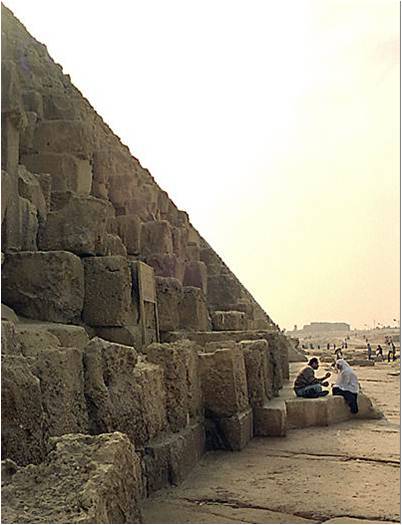
The Pyramid of Chefren (below):